
Optimizing Fertilizer Practices in Your Container Garden Part 2: Nutrient Deficiency and Toxicity Management
Introduction
Container plants, like all living organisms, experience stress that affects their growth, health, and productivity. Plant stress can be a result of multiple factors, including excess water, lack of water, too much shade, too much sunlight, pathogen infection, pest damage, and nutrient imbalances. Determining the root cause of the problem requires detective work. But with the proper tools and knowledge, you can get closer to determining the source and potential solution to plant stress in container plants.
Nutrient imbalance is one factor that can lead to plant stress. Healthy plants require a balanced supply of essential nutrients for optimal growth and development. The nutrients most commonly deficient in substrate are the big 3: Nitrogen (N), Phosphorus (P), and Potassium (K). N, P, and K are often deficient because they are needed in larger quantities, compared to other essential nutrients.
Nutrient deficiency occurs when a plant is unable to absorb enough of one or more essential nutrients. This can happen due to improper fertilization practices, poor soil quality, pH, or competition from weeds. In addition, container plants are particularly susceptible to nutrient deficiency, due to substrate’s low cation exchange capacity (ie, ability of substrate particles to hold on to nutrients). Dissolved nutrients can easily drain out of the bottom of the container, making them unavailable for plant uptake. This process is called leaching, and this can occur when you water your plants. In contrast, nutrient toxicity occurs when plants absorb excess amounts of certain nutrients, leading to negative growth impacts. This can happen due to a high concentration of fertilizer salts in solution.
Factors Affecting Nutrient Uptake
Fertilization practices are the most obvious source of nutrient-related plant stress. If you don’t apply enough fertilizer to your container plant, then it won’t be able to take up enough essential nutrients. If you over-apply fertilizer, then a plant can take up too many nutrients and express symptoms of toxicity. But even if you apply the perfect amount of N, P, K, etc., plants can still express symptoms of nutrient deficiency or toxicity. Let’s take a minute to understand the other environmental factors that affect nutrient uptake.
pH
pH measures how acidic or basic a solution is, based off the number of H+ ions that are present. A pH value of 7 means that the solution is neutral. A value less than 7 means that the solution is acidic, and a value higher than 7 means that the solution is basic. There are easy-to-use test strips that can provide the pH value of the water you use to irrigate, and the water that drains out of the bottom of your pot.
pH can negatively impact the availability of nutrients to a container plant. This idea is illustrated in Figure 1, where wide bars indicate high nutrient availability at a specific pH. As the bar narrows, the nutrient becomes less available. For example, Figure 1 shows that magnesium availability decreases as pH decreases. Conversely, iron availability decreases as pH increases. An ideal pH is between 6 and 7. This is the range where nutrient uptake is least inhibited by pH for most of the essential plant nutrients.

Figure 1: Table displaying the relationship between nutrient availability and pH in substrates (Handreck and Black 1999, pg. 86)
Nutrient Antagonism
In addition, nutrients themselves can affect the availability of other nutrients. This is what we call nutrient antagonism. For example, high levels of potassium can cause magnesium and calcium deficiencies. High levels of phosphorus can cause iron and zinc deficiencies. It is difficult to determine that nutrient antagonism is the source of plant stress without expensive lab services. Try the troubleshooting methods explained in the Correcting Nutrient Deficiencies and Toxicities section, before reaching out to a professional lab for their services.
Competition
Weeds are less common in container environments, compared to soil environments. Nevertheless, it’s important to understand that weeds can compete with garden plants for resources, including nutrients. Hand weeding is the best management practice in a home container garden. Just wear gloves in the case of any pesky nettle.
Nutrient Deficiency and Toxicity Symptoms
When a plant is stressed due to nutrient deficiency or toxicity, it will often express physical symptoms. Symptoms can vary from nutrient to nutrient, and from species to species. For example, tomatoes express calcium deficiency through the development of rotten fruit. This is known as blossom end rot. In contrast, gerbera daisies express calcium deficiency through leaf browning (also known as necrosis). That said, there are general symptoms to look out for when you suspect nutrient deficiency or toxicity. See Table 1 for a full list of common symptoms.
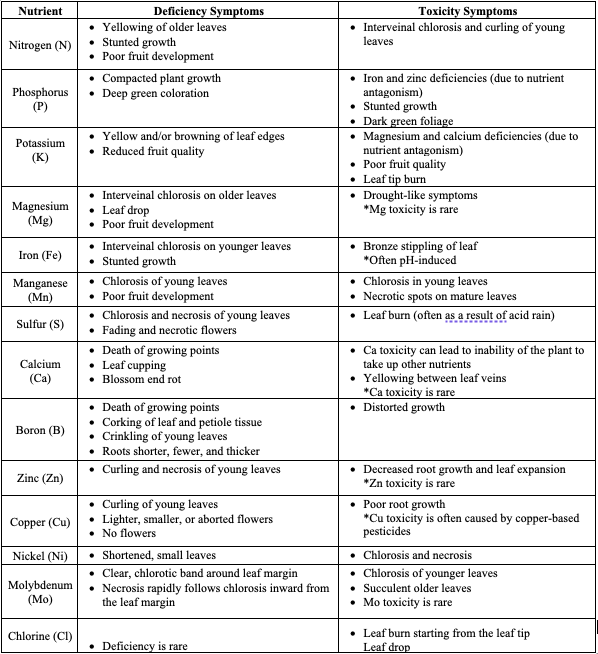
Table 1: Common nutrient deficiency and toxicity symptoms. Not all plants express deficiency and toxicity symptoms the same way, so use this as a problem-solving tool.
Correcting Nutrient Deficiencies and Toxicities
Nutrient Deficiencies:
Apply fertilizer. If you determined that a lack of nutrients is the most likely cause, you should apply fertilizer. There are plenty of fertilizer options available at gardening stores. Again, see part 1 of this series for a description of the different fertilizer options available.
Adjust pH. If you determined that your pH is too low or too high, and it appears to affect nutrient availability, you should adjust your pH. If the substrate pH is too high, you should apply sulfur to lower it. If the substrate pH is too low, you should apply lime to increase it. There are plenty of products intended for home gardeners to adjust pH. Follow the label’s instructions for application.
Incorporate controlled release fertilizers (CRFs). CRFs are a great way to ensure that your plants receive a baseline amount of nutrients. They can be incorporated into the top 1-3 inches of your pot, and they will slowly release nutrients into the substrate. Incorporating CRFs when you first pot your plant, and regularly applying a liquid fertilizer, is a great way to prevent nutrient deficiency.
Nutrient toxicities:
Leach water from your pot. Water the substrate so that enough water to fill approximately 50% of your pot drains out of it. This will rid your pot of a majority of the nutrients applied, and you can adjust your fertilizer practices based off of your plant’s requirements and fertilizer label instructions.
Decrease fertilizer application. Minimize the frequency and/or rate of fertilizer application. There are plenty of resources available to determine the nutrient needs of common garden plants. Do your research, read the fertilizer label, and grow a beautiful, healthy plant.
Conclusion
It is important to keep in mind that while a plant may express symptoms of nutrient deficiency or toxicity, that this does not necessarily mean that nutrients are the root cause of plant stress. There are plenty of other plant stressors that can cause similar symptoms. It is up to you, the plant detective, to study the plant’s history and determine the most likely cause.
Sources
Costello, L.R., Perry, E.J., Matheny, N.P., Henry, J.M., & Geisel, P.M. (2003). Abiotic Disorders of Landscape Plants: A diagnostic guide. University of California Agriculture and Natural Resources.
Handreck, K., Black, N. (1999). Growing Media for Ornamental Plants and Turf. University of New South Wales Press.
Li, J., Jia, Y., Dong, R., Huang, R., Liu, P., Li, X., ... & Chen, Z. (2019). Advances in the mechanisms of plant tolerance to manganese toxicity. International Journal of Molecular Sciences, 20(20), 5096.
Merhaut, D. J., Williams, K. A., Mangiafico, S.S. (2018). Water, Root Media, and Nutrient Management for Greenhouse Crops.
Roques, S., Kendall, S., Smith, K., Price, P. N., & Berry, P. (2013). A review of the non-NPKS nutrient requirements of UK cereals and oilseed rape. HGCA.
Authors
Emma Volk, University of California Cooperative Extension, Ventura and Santa Barbara Counties
Bruno Pitton, University of California Cooperative Extension, Placer and Nevada Counties